
Small Loan Amounts: How $150 to $4,000 Loans Work
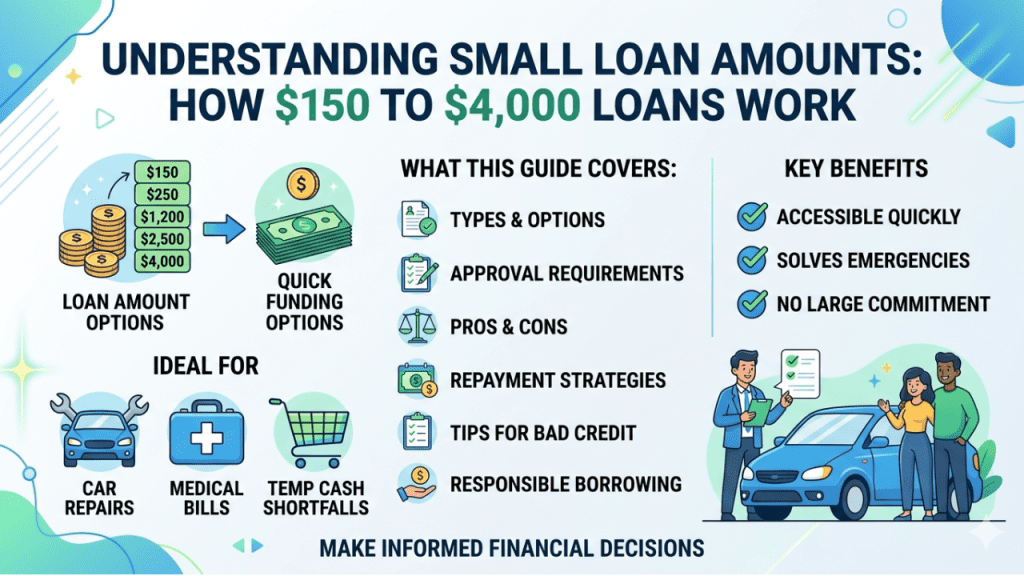
For those needing fast cash, if you’re looking for quick funding options to cover emergencies or short-term expenses, small loan amounts are a practical solution. Additionally, borrowers can access loans ranging from $150, $250, $1,200, $2,500, and $4,000, making it easier to meet urgent financial needs without committing to large personal loans. These loans are ideal for situations like unexpected car repairs, medical bills, or temporary cash shortfalls.
This comprehensive guide covers everything you need to know about small loan amounts: types, approval requirements, pros and cons, repayment strategies, tips for bad credit borrowers, and responsible borrowing strategies. By the end, you’ll have all the information to make informed decisions and select the loan that fits your needs.
What Are Small Loan Amounts?
Small loan amounts are personal or short-term loans designed for smaller-scale financial needs. In contrast, unlike traditional personal loans, which may require extensive credit checks and larger repayment commitments, these loans provide accessible options for borrowers needing smaller amounts of cash.
Small loans are structured to be easy to access, provide fast cash, and require minimal paperwork. As a result, they are ideal for borrowers who need temporary financial relief without a long-term commitment.
Why Small Loans Are Popular
- Fast access to cash: Many lenders provide funds within 24 hours.
- Limited borrowing reduces risk: Smaller loan amounts are easier to repay.
- Flexible approval: Often available to borrowers with low or no credit history.
- Targeted solutions: Ideal for emergency bills, urgent expenses, or short-term cash flow needs.
- Convenient application: Online applications make borrowing quick and simple without visiting a bank.
Why Borrowers Search for Small Loans
Borrowers often seek small loan amounts for a variety of reasons:
- Emergency expenses: Sudden car repairs, medical emergencies, or urgent travel.
- Daily needs: Groceries, utility bills, or temporary rent shortages.
- Special occasions: Birthdays, weddings, or family emergencies.
- Short-term cash flow management: Bridging the gap between paychecks.
Overall, these loans are designed to provide financial relief quickly, without the complexity of larger loan products. As a result, many borrowers find them less stressful than large loans because repayment amounts are manageable and short-term.
Common Loan Amount Ranges
| Loan Amount | Typical Use | Repayment Type |
| $150 | Small emergency | Payday |
| $250 | Short-term expenses | Payday |
| $1,200 | Larger emergency | Installment |
| $2,500 | Major expense | Installment |
| $4,000 | Large financing | Installment |
Each loan amount serves a distinct purpose and comes with different terms, repayment options, and approval requirements. Therefore, borrowers can choose the loan that best aligns with their financial situation and repayment capacity.
Typical Small Loan Amounts Options
$150 Loans
$150 loans are the smallest small loan amounts, perfect for urgent minor expenses. Typically, they are offered as payday loans, which are short-term loans due on your next paycheck.
Use Cases:
- Gas or transportation repair
- Urgent groceries
- Minor medical co-pays
- Small utility bills
Repayment Example:
- Loan Amount: $150
- Interest Rate: 15% APR
- Repayment Term: 14 days
- Total Repayment: $172.50
In fact, these loans are designed for speed and convenience, allowing borrowers to handle unexpected small expenses efficiently.
$250 Loans
$250 loans provide more flexibility for slightly larger short-term needs. They can be payday or short-term installment loans.
Use Cases:
- Rent or utility payments
- Minor vehicle repair
- Emergency medical expenses
- Short-term childcare needs
Repayment Example:
- Loan Amount: $250
- Interest Rate: 12% APR
- Repayment Term: 3 weeks
- Total Repayment: $280
$1,200 Loans
$1,200 loans are mid-range small loan amounts suitable for larger emergencies or planned expenses.
Use Cases:
- Car repairs
- Minor surgical procedures
- Home appliance replacement
- Temporary cash flow gaps
Repayment Example:
- Loan Amount: $1,200
- Interest Rate: 18% APR
- Repayment Term: 6 months
- Total Repayment: $1,308 (approx. $218/month)
$2,500 Loans
Specifically, $2,500 loans are designed for major expenses while offering manageable repayment terms.
Use Cases:
- Home renovations
- Dental procedures
- Vehicle maintenance or purchase
- Emergency medical bills
Repayment Example:
- Loan Amount: $2,500
- Interest Rate: 15% APR
- Repayment Term: 12 months
- Total Repayment: $2,875 (approx. $240/month)
$4,000 Loans
$4,000 loans are the largest in the small-loan category and are suitable for significant financing needs.
Use Cases:
- Major home repairs
- Vehicle purchase
- Debt consolidation
- Extended medical expenses
Repayment Example:
- Loan Amount: $4,000
- Interest Rate: 12% APR
- Repayment Term: 24 months
- Total Repayment: $4,480 (approx. $187/month)
How Loan Amount Approval Works
Approval for small loans depends on several factors:
Income Requirements
Lenders require proof of stable income to ensure repayment ability. Specifically, for smaller loans, lower amounts may require only a minimum monthly income of $1,000, whereas higher amounts may require verification of steady earnings or additional documentation. In this process, lenders assess affordability and risk before approving the loan.
Bank Account Verification
A verified checking account allows for:
- Direct deposit of funds
- Automated repayments
- Fraud prevention
Consequently, borrowers with a verified account can access funds faster, enjoy seamless repayment processes, and benefit from added security, making the borrowing experience more convenient and reliable.
Credit Score Considerations
- Payday loans: Often, no credit check.
- Installment loans: Credit score affects approval and interest rate.
- Bad-credit borrowers: Specialized lenders may approve loans even with low credit scores, though rates may be higher.
Loan Types by Amount
Small Payday Loans
Short-term, fast-approval loans, typically under $500, are ideal for urgent small expenses such as minor car repairs, medical bills, or unexpected utility payments. These loans provide quick access to cash with minimal documentation, allowing borrowers to address immediate financial needs without long-term commitments.
Pros:
- Immediate funding
- Minimal documentation required
Cons:
- High interest rates
- Short repayment periods can be challenging
Installment Loans
Loans are repaid in fixed monthly installments over a longer term, which additionally provides predictable payments and helps borrowers manage their budget more effectively.
Pros:
- Predictable payments
- Suitable for larger loan amounts
Small Loan Amounts for Bad Credit
Special lenders offer small loans to people with bad credit. As a result, borrowers with low scores can still access funds if they meet income verification and repayment conditions.
Tips:
- Only borrow what can be repaid on schedule
- Avoid rolling over loans repeatedly
- Make timely payments to improve your credit history
Same Day Small Loans
These loans allow borrowers to access funds the same day they are approved. Additionally, fast processing is available through online applications.
Tips for Approval:
- Apply early in the day
- Provide accurate bank and personal details
- Select lenders known for fast funding
Pros and Cons of Small Loan Amounts
| Pros | Cons |
| Fast funding | Higher interest rates |
| Small borrowing amount | Short repayment terms |
| Easier approval | Possible fees |
| Flexible repayment options | Potential for repeated borrowing |
For example, a $250 loan may cover urgent groceries immediately, but could cost $30 in fees if not repaid on time.
How to Apply for Small Loan Amounts
Applying for a small loan is designed to be fast, simple, and convenient, especially when using online platforms. To ensure this, following these steps ensures a smooth application process and helps avoid delays or misunderstandings.
Step 1: Apply Online
First, begin by visiting the lender’s website or mobile app. Next, complete the online application form accurately, providing all required personal information such as your full name, date of birth, and contact details. Then, include employment details to verify your income and stability. After that, add banking information for direct deposit and automatic repayments. Finally, double-check entries to avoid errors that could delay approval.
Step 2: Review Loan Offer
After submission, the lender will assess your application and provide a loan offer. Next, carefully review interest rates, fees, and repayment terms. Additionally, consider the total repayment amount and the schedule to ensure it fits your budget. Also, look for any hidden charges and compare with other lenders if needed. By following these steps, you can make an informed decision before accepting the loan.
Step 3: Accept Terms
Once you have reviewed the loan offer, agree electronically to the terms and conditions. Be sure to understand all obligations, including the repayment schedule and any penalties for late or missed payments. By signing the agreement, you confirm your commitment to repay the loan as agreed, establishing a legal contract between you and the lender.
Step 4: Receive Funds
Once accepted, funds are typically deposited directly into your bank account, often on the same day or within 24 hours. Afterward, check that the correct amount has been credited and confirm the repayment dates. Additionally, plan your budget to ensure timely repayment and avoid late fees or additional interest, keeping your borrowing experience smooth and stress-free.
FAQs About Small Loan Amounts
The smallest loan is typically $150 and is designed for minor emergencies. For example, payday loans are common at this level, providing fast funding with minimal documentation. Repayment usually occurs on your next paycheck. As a result, these loans offer a convenient short-term solution to cover immediate expenses without long-term obligations.
Yes, many lenders allow online applications for $150 loans. Online borrowing is fast and convenient, often requiring minimal documentation. Once approved, funds are deposited quickly, sometimes the same day. This makes it an ideal option for urgent small-scale expenses like groceries, transportation, or minor medical bills.
Credit requirements vary by loan type. For example, payday loans often do not require a credit check, while installment loans may need a minimum score of 580. However, borrowers with poor credit can still access some small loans, although interest rates may be higher. Over time, responsible repayment can help improve future borrowing eligibility.
Yes, certain lenders specialize in small loans for bad credit. As a result, these loans provide access to urgent funds even if your credit score is low. In most cases, approval may require proof of income or a bank account. However, borrowers must plan repayment carefully to avoid late fees or worsening financial challenges.
Funding speed depends on the lender and the loan type. In many cases, payday and small installment loans offer same-day funding once approved. Additionally, providing accurate personal and bank information accelerates processing. As a result, borrowers can access funds quickly to handle urgent needs, such as emergency repairs, medical bills, or essential living expenses.
$1,200 loans often have repayment terms of 3–12 months in fixed monthly installments. As a result, payments cover both principal and interest, providing a predictable cash flow. Additionally, some lenders offer automated or online payment options, reducing the risk of missed payments. Therefore, careful planning ensures the loan can be repaid on time without financial strain.
Large loans, such as $4,000, generally require credit verification or proof of income. However, tribal or special lenders may offer flexible terms with limited credit requirements. Although approval without a credit check is rare, some borrowers can qualify by providing documentation of stable income or a history of timely repayment on smaller loans.
Small payday loans are safe when borrowed responsibly from licensed lenders. Therefore, understanding interest rates, fees, and repayment terms is crucial. Additionally, borrow only amounts you can repay on time to avoid fees and debt cycles. Furthermore, choosing reputable lenders helps ensure legality, transparency, and protection against predatory practices.
Additionally, some lenders allow refinancing to extend repayment or adjust monthly payments. While refinancing can ease financial pressure, it may increase total interest costs. Therefore, borrowers should carefully evaluate fees and terms to ensure refinancing provides net benefit. Overall, it is a tool to manage repayments more effectively when necessary.
Payday loans generally do not report to credit bureaus, so they may not impact your score. In contrast, installment loans are reported, meaning on-time payments can improve your credit, while missed payments may lower it. Therefore, understanding reporting policies ensures borrowers manage credit responsibly and avoid unexpected effects on future borrowing.
First, reputable lenders disclose all fees upfront, including processing, late, or service charges. However, hidden fees are uncommon with licensed lenders, but borrowers should read the loan agreement carefully. Understanding the cost structure helps ensure there are no surprises and avoids financial stress or excessive repayment obligations.
Common documents include a valid government-issued ID, proof of income like pay stubs or bank statements, and an active checking account for deposits and repayments. Additionally, some lenders may require proof of residence. By providing accurate documentation, applicants streamline the application and ensure faster approval and fund transfer.
Yes, early repayment is often allowed and can reduce interest costs. Check with your lender for any prepayment penalties. Paying early helps minimize total repayment, avoid late fees, and improve financial flexibility. Therefore, it’s recommended to plan repayment to take advantage of interest savings whenever possible.
Installment loans are better suited to larger amounts or longer repayment terms, offering fixed monthly payments and less stress on cash flow. For instance, payday loans provide rapid funding for small, urgent needs but usually carry higher interest and shorter terms. The choice depends on loan size, urgency, and repayment capacity.
Some lenders allow multiple loans, but borrowers should consider their repayment capacity. However, taking several loans simultaneously can strain finances and increase fees. Therefore, responsible borrowing means planning repayment schedules to avoid overlapping obligations. Additionally, always check lender rules to ensure simultaneous loans are permitted and manageable.
Yes, most lenders require an active checking account to deposit funds and schedule automatic repayments. As a result, a verified account ensures faster access to funds, reduces errors, and simplifies repayment. Otherwise, borrowers without accounts may face delays or be ineligible for certain lenders offering small or same-day loans.
Interest rates depend on the loan amount, repayment term, credit score, and lender policies. For example, higher credit risk or short-term payday loans may carry higher rates, while installment loans with good credit often have lower APR. Therefore, understanding how rates are calculated helps borrowers plan repayments and manage total loan costs.
Typically, small loans under $500 do not require a co-signer. However, larger amounts, like $2,500–$4,000, may require a co-signer if the borrower has low income or poor credit. In this case, a co-signer shares repayment responsibility, helping borrowers qualify for higher loan amounts or better interest rates.
Yes, small loans can cover travel expenses such as flights, hotels, or emergency trips. However, borrowers should plan repayment carefully and ensure the cost aligns with their budget. By doing so, using loans responsibly for travel helps prevent financial strain and ensures funds are available when urgent needs arise.
Loan legality varies by state. For example, regulations affect interest rates, maximum loan amounts, and the availability of payday loans. Therefore, borrowers should verify local lending laws to ensure compliance. Additionally, licensed online lenders will comply with state regulations, providing safe, legal borrowing options for small loan amounts.
Yes, installment loans reported to credit bureaus can help improve credit if repayments are timely. Consequently, consistent on-time payments demonstrate reliability, which may increase credit scores and future borrowing opportunities. However, payday loans may not report to credit agencies, so their impact on rebuilding credit is limited.
In some cases, tribal lenders offer loans between $150 and $4,000. Additionally, these loans may follow different regulations than state laws and can provide flexible credit options. Therefore, borrowers should understand terms, interest rates, and repayment obligations. As a result, tribal loans can be a viable alternative for small emergency funding.
Missing a payment may incur late fees, additional interest, and a potential negative impact on credit if reported. In some cases, lenders may offer extensions or payment plans, but repeated missed payments increase financial stress. Therefore, borrowers should communicate promptly with lenders to avoid penalties and maintain good repayment standing.
Yes, many lenders allow higher loan amounts after successfully repaying previous loans. As a result, responsible borrowing and timely repayment improve eligibility for larger amounts. However, borrowers should evaluate their income and repayment capacity before requesting higher loans to avoid overextension and potential financial strain.
Compare lenders by interest rates, fees, approval speed, repayment terms, and reputation. Additionally, reading reviews, checking licensing, and understanding all costs ensure the selection of a responsible lender. As a result, comparing options helps borrowers secure favorable terms, lower costs, and quick access to funds when needed.
